Volcano is coming
Evacuation to logging camp
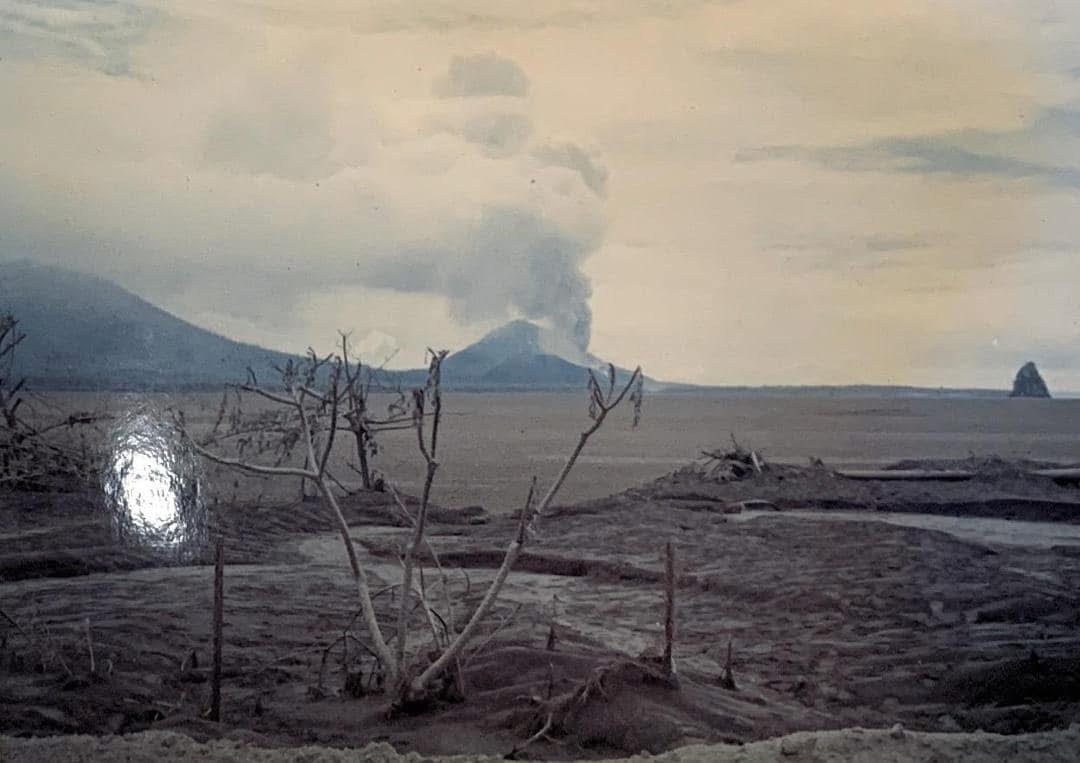
Rabaul — The Night the Mountain Woke Up
18 September 1994
At 3.30 in the morning we were awakened by an earthquake.
I sat bolt upright in bed.
“There’s another one coming.”
Not exactly the sort of bedside prediction your wife wants to hear at 3.30 am.
For the next 27 hours the earthquakes kept coming. We scurried around packing, gathering people and preparing to evacuate Rabaul. Our destination was a friend’s house at Nonga — out of town, out of the caldera and around the next bay.
That seemed considerably more sensible than sitting inside a volcanic caldera waiting to see what happened next.
All night small aircraft were flying overhead. Night flying into Rabaul airport wasn’t normally allowed, so we knew this was serious.
National Disaster in Port Moresby rang me during the night. They needed fuel from us for new Ela Motors vehicles being used to ferry people from Queen’s Park, where residents had been told to gather.
While I was in town I looked at my 16,000-litre fuel tanker and thought perhaps leaving sixteen tonnes of fuel sitting in the middle of a volcanic disaster wasn’t one of my better business strategies.
So I drove it over Tunnel Hill to somewhere safer.
I put it into first gear for the climb.
And never changed gear.
This was not a night for fuel economy.
I went back to my house to check for looters, turn off the gas and give the pets another feed and water. Then, because priorities are priorities, I sent a computer fax to my boys at boarding school in Canada:
We are evacuating Rabaul. Canberra beat Canterbury.
One should never allow a volcanic emergency to interfere with the rugby league results.
By morning we had about 40 people wanting showers, so my German business partner went back into town to check his house and clean himself up.
He came racing back.
“THE VOLCANO IS ERUPTING!”
We all went outside.
Over the hill a huge plume of ash was climbing into the sky.
There are moments when the brain takes a little while to catch up with what the eyes are seeing.
This was one of them.
We abandoned the sedans and loaded everyone into a truck and two four-wheel drives fitted with radios. There were perhaps 40 or 50 people in our convoy.
My fifth son was only 17 months old and was with my ex-wife in the last vehicle. I sat in the cab of the truck while two of my boys, aged nine and seven, travelled under the canvas in the tray.
Then we joined the exodus.
The North Coast Road was bumper to bumper.
People were walking carrying whatever possessions they could grab. Bags. Clothes. Pots. Saucepans.
When your volcano erupts, apparently the saucepan suddenly becomes a family heirloom.
Empty vehicles were racing back towards Rabaul to collect more people while everyone else was desperately trying to get out.
At one point our convoy stopped briefly.
Unbeknownst to me, two mothers saw the truck loaded with evacuees and made an instant decision. They threw their children onto the back of it.
Nobody stopped them.
The mothers then turned around to collect their belongings.
And we drove off.
With their children.
I knew absolutely nothing about this.
By Kerevat the rain started. It mixed with the volcanic ash and hit the windscreen like continuous bird droppings from some prehistoric bird with a serious digestive problem.
Above us, the ash plume continued climbing.
At Kerevat we turned left, deliberately crossing through the ash deluge, heading towards Put Put via the Warangoi Bridge.
We were running short of diesel, covered in ash and looking increasingly like a convoy of badly made concrete statues.
At the first river we stopped and everyone piled into the water to wash off the ash and mud.
My glasses came off.
Wonderful.
Volcano erupting. Family evacuated. Business somewhere underneath an ash cloud.
And now I was blind.
A kid dived into the river and retrieved them.
Civilisation restored.
Eventually we reached a logging camp and begged for somewhere to stay. They gave us a copra shed — essentially a barn without a door — while the management families got a manager’s house.
It wasn’t the Hilton, but nobody complained about the minibar.
A few days later our maid approached my ex-wife.
“This baby is going to die if it doesn’t get milk.”
“What baby?”
That was when we discovered the full extent of our passenger manifest.
Five children.
The oldest was about 13.
The youngest was a five-month-old breastfed baby.
And there was no mother.
Somewhere during the evacuation, two mothers had thrown their five children onto my truck, turned around to collect their belongings — and watched their children disappear down the North Coast Road with Paul Bluett.
We found a bottle.
We found some Sunshine milk powder.
And suddenly, in addition to evacuating my own family, my staff, friends and assorted refugees while wondering whether my business still existed, I was responsible for five children whose surnames I didn’t even know.
We put a message out over NBC radio.
Eventually word came back:
Take the children to the sports field evacuation camp in Kokopo.
No bloody way.
“Bring the mothers to me.”
The police eventually brought the mothers all the way out to where we were staying.
And we handed their five children back.
I kept no names.
No addresses.
No photographs.
Nothing.
My life had been turned completely upside down.
I lost three houses, three flats and three shops. I nearly went broke.
But that’s another story.
The strange thing is that when I tell stories about the eruption, I can laugh about the tanker crawling over Tunnel Hill in first gear. I can laugh about sending my sons in Canada the Canberra–Canterbury score while evacuating a volcano. I can laugh about the ash looking like endless bird shit on the windscreen and losing my glasses in the river.
But when I get to those five children, I can’t laugh.
I cry.
Every time.
In the middle of one of the greatest natural disasters in Papua New Guinea’s modern history, two terrified mothers had made a split-second decision.
They saw a truck heading away from an erupting volcano.
They put their children on it.
And trusted complete strangers to keep them alive.
For a few days, somehow, those five children became ours.
More than three decades later, I still don’t know their names.
But I have never forgotten them.
I don’t think I ever will.
And acquiring five children in one hit was surely a living dream — the sort of dream only Joseph could have interpreted. Five children had appeared in my life, and somewhere in the fine print of destiny was the prophecy that another five were still to come. Ten children! Even Joseph might have woken up sweating.