The Place
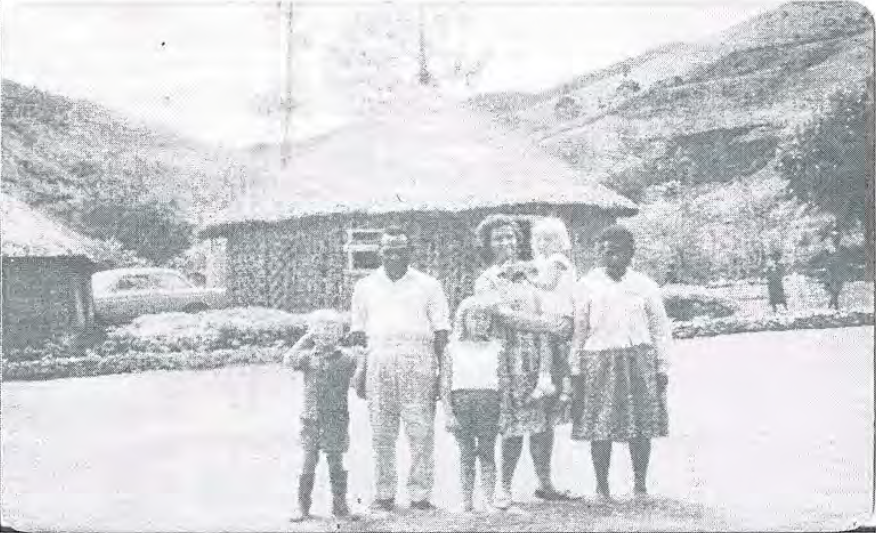
Margaret Bluett — Highland town of Goroka, where the Bluetts landed and promptly ignored the advice never to stay in a village.
When my family arrived in what was then known as the Territory of Papua New Guinea, twenty years after the Second War ended in the Pacific, the country was beginning to display the effects of a fresh approach in the way Australia administered the country. During the first ten years, the Administration focussed on a reconstruction process which entailed a mopping up of the damage done during the war years. Repairs were carried out in the major towns and affected villages but evidence of the war was still visible in the main towns and along the coast. Many places had witnessed and experienced the effects of hand to hand fighting, bombing raids, and devastation to crops, the subsistence people depended on. Coastal seas were peppered with rusting warships; towns were destroyed and hills around Rabaul were honeycombed with tunnels the Japanese built to escape the American bombing raids. Many buildings erected as temporary structures during the war proved to be useful even after the war ended; the Quonset huts in Manus and Angau Hospital wards in Lae (built of pre-fabricated structures erected by soldiers), Marsden Matting, that ubiquitous piece of crafted metal used by the Americans to create instant landing sites for aircraft and paths, was used all over the country to create walkways through mud.
There were sadder traces of war in the major towns; such as cemeteries, rusting guns, and unexploded bombs. The memories of war last for generations and stories in the minds of veterans, who came to love the country and became soldier settlers, were told to anyone who would listen to them. There were reports of the lack of compensation for old men in villages never rewarded for the role they played and the losses they sustained during the conflict. Nevertheless, the new policy approach with a limited budget attempted to address the major issues outlined by the Minister of External Territories E.J. Ward in September 1945,
'This Government is not satisfied sufficient interest had been taken in the Territories prior to the invasion by the Japanese or that adequate funds had been provided for their development and the advancement of the native inhabitants ... advancement can be achieved only by providing better health, better education and for a greater participation by the natives in the wealth of their country and eventually in the government.'
Government policies, however positive, were insufficient to change the negative attitudes of many expatriates in Papua New Guinea. The first Baha'i pioneers who arrived in the nineteen fifties suffered from the effects of social segregation and were punished for their attempts to socialise with local people. But that is their story, this story begins in 1965 when the second wave of pioneers began to arrive. The country was still regarded as an Australian Territory and it was relatively easy for Australians or New Zealanders to settle in either Papua or New Guinea providing they had sufficient income to sustain themselves or prior employment with either the public service or private companies. These institutions were expected to provide their employee's incomes, housing and expenses for travel and children's education. Thus, the later pioneers met better conditions than those who arrived in the 1950s.
On our arrival in Port Moresby, in the mid nineteen sixties, we found a town resembling in many ways an Australian country town, with a couple of hotels, timber buildings, tropical style houses for expatriates, some tarred roads, an efficient airport, and other modern facilities. However, the big difference between Australian towns and those of Papua and New Guinea were the large number of local people who congregated in the centres in a process known as urban drift. Villagers, particularly young males, were leaving their homes to find work. Many gained employment and worked as house servants, gardeners, or employees in government services such as the police or security and some worked for missions, schools, or other charitable organisations but there were insufficient positions to accommodate all the unemployed individuals.
The Administration relied heavily on Christian Missions for their contribution in providing schools, aid posts and other benefits especially in remote areas. Mission policy therefore continued to resist any attempt to introduce enlightenment ideas such as the Baha'i concept that all humanity belonged to the same family or that all the prophets of God received their teachings by divine inspiration. To Christians there was only one way, that of Jesus and the Bible, and they maintained the belief that only Christian Missions should be allowed to establish centres in Papua New Guinea. Because the Government needed them the Missions had a powerful influence on policy and practice even into the mid twentieth century but were subject to some restrictions. Missions were not allowed to proselytize in territory regarded as belonging to a different mission, a policy referred to as 'spheres of influence'. This policy came into the language of the administration when religious conflict between Missions arose during the latter part of the nineteenth century. The Lieutenant Governor Sir William McGregor, who arrived in Moresby in 1888, set in motion policies he hoped would keep the peace including the 'spheres of influence' which restricted missions from trying to gain converts in areas already settled by other missions. Sir Hubert Murray who succeeded him as Governor of Papua in 1908 continued to honour this policy as well as positive concepts of his predecessor such as involving Papuans in development projects such as establishing plantations and the practice of diplomatic mediating between various missions. A public servant in Moresby told me that Sir Hubert Murray declared his administration would not do to the Papuan people what we had done to the Aboriginal people of Australia. They did not intend to alienate people from their land nor disperse tribal people to other areas unless it was necessary.
The policies set in place by these two governors still influenced the attitudes of missionaries in the nineteen sixties who felt they had the right to prevent the introduction of new ideas or religious practices in their area. Consequently, after the London Missionary Society bequeathed their territory to Anglicans they were the prevalent mission in Papua, the Lutheran heritage from the German occupation prevailed in Northern New Guinea while Catholicism was predominant in New Britain, Wewak, and the Sepik region, while Methodists prevailed over areas in Milne Bay. After two world wars this policy weakened considerably and other Christian sects began to establish organisations wherever they found an audience. However, it was still difficult to teach anything other than Christianity and this affected the first pioneers who found indignant opposition to their teaching in most areas. However, it worked in favour of teaching in the areas where the Missions did not treat the people well or gave the impression missionaries were superior to the 'native population'. Conflict between Methodists and Catholics in New Ireland, for example, led to the ideas of the Faith appealing to those who had suffered from the prejudice of one group against another.
Patronizing and negative attitudes towards local people still existed among many expatriate groups in the 1960s. Papua New Guinea adult males were still called boys and collectively local women were known as 'meris' in the 1960s and many individuals who worked for the benefit of local people tended to adopt a paternalistic approach. Security issues in Moresby and Lae were prevalent in the talk of expatriates as large numbers of unemployed youth, without support of their families or their own land, turned to stealing to survive. Newly arrived expatriate women were warned by those who had arrived years earlier to act in a modest manner so as not to attract the attention of local men either unemployed youth or house servants. Female clothing showing too much skin was frowned upon by older ladies even though the coastal climate was hot and humid.
Shops were mainly trade stores with a few department stores in major centres belonging to Burns Philp and Steamships, both long term trading companies in the Pacific. The planes arriving in Moresby from Brisbane were mostly DC 6s and internal travel between towns was mostly in the DC 3s that were used during the war, a few still had side saddles for seating. Smaller planes were used in the interior or on the coast and provided a panoramic view of the countryside but a bumpier ride for passengers. All cargo from overseas arrived by ship in the three major ports, Moresby, Lae and Rabaul. Cargo for the interior was carried in big planes which if I remember correctly were De Havilland aircraft able to carry large quantities of food and equipment.
My family's experience in Papua New Guinea began in February 1965 after my husband secured a position in the Highland town of Goroka as the first Executive Officer of the Papua New Guinea Coffee Marketing Board. Many people in our hometown of Canberra were surprised at our seemingly sudden departure from that of a secure future and a safe suburban life amongst friends and relations to the remote mountains of New Guinea. My husband had a flourishing Accountancy Practice in Canberra and our five children were in good schools; in fact we lived with conditions that most of the population of Australia would envy. The question our friends who were not Baha'is asked us: 'Why are you doing this?'
We were responding to a call from the Universal House of Justice made in 1964 after they had been elected at the International Conference in Haifa in 1963. They made teaching plans for all the National Assemblies in each country which were announced to the delegates attending the National Conventions held during Ridvan. As mentioned in my previous book 'Birds into Paradise', the Australian plan had eighteen goals, nine of which applied to the Faith in Papua New Guinea. Australian believers were given the task of parenting the community towards its maturity — that is the establishment of its own National Assembly and all that implies.
It took us three days with night stopovers in Brisbane, Port Moresby and Lae to arrive at our destination in Goroka, travelling on the final leg in a DC 3 sitting side saddle. Not long after we arrived the Podger family also arrived and settled in Moresby. Seven pioneers were already living in the country when we arrived, six in Rabaul and one in Lae, but no pioneers resided in the Highlands. We were excited at the prospect of living in untouched territory, convinced it was our duty to pioneer and delighted with the idea of being in a completely different and adventurous environment. We were young and naïve enough not to think about the problems we would encounter, absolutely devoted to the Faith, confident we would be protected and assisted by Divine Assistance when endeavouring to play a role in the establishment of the New World Order through the teachings of Baha'u'llah.
Most of our experiences on arrival in Goroka were printed in 'Birds into Paradise', no need to repeat them here, however it is feasible to repeat the notion that we found ourselves in a Shangri-La type environment containing approximately two hundred expatriates and un-numbered thousands of Highlanders who lived in villages surrounding the township. Some young men worked in town as cook boys, houseboys, gardeners, or government service employees but the majority went home at night leaving the township enveloped in an eerie silence and I learned in those first few months what it felt like to be a stranger in a strange land.
The scenery we found in Goroka was so magnificent it almost defies description; the paradise described in the Koran comes to mind. There were gardens beside which rivers flowed, dark eyed maidens and no doubt many were virginal, protected for their commercial value as brides. They walked the streets together on market days wearing minimal clothing of swaying skirts and bosoms adorned with necklaces of beads and shells. Flowers, fruit, and vegetables flourished in the rich black volcanic soil and magnificent mountain ranges of varying hues stretched into the distance in every direction. The climate was idyllic, misty mornings, sunny days with low humidity, cool nights, and refreshing breezes. Most of the year it rained in the night or late afternoon and in the wet season it poured down in torrents of sparkling water that turned the roads into seas of mud and the channels, known as barets, flowed beside the streets into clear streams. The township of Goroka was orderly and peaceful and I felt blessed to be a pioneer in such beautiful surroundings.
The town resembled an island surrounded by mountains with one hotel, three trade stores, an outdoor market and tree lined streets of houses built for expatriates, mostly timber with some made of red bricks. The original settlers built a small brick kiln to make bricks for official buildings but it didn't last long, timber was easily available and economical. The centre of town included the District Office, a small Post Office, a Police Station, a flag pole and three small churches — Anglican, Catholic and Lutheran — demonstrating the main mission influences in the area. Every morning and evening the Australian flag was raised and lowered without the help of a bugle but a small contingent of police in uniform would march up and down along the hundred yards of tarred road intending to give the impression the Australian Administration was present and in control, determined to maintain the peace.
The people who lived in the surrounding villages fascinated me. They looked very friendly, smiled easily. They walked through town in groups heading for the market, the obvious gathering place, chattering and laughing amongst themselves and greeting each other affectionately. Occasionally groups in ceremonial costume would dance through the town beating their drums, including bride price processions which traditionally carried items such as pigs, vegetables, feathered headdresses, or shells but after the arrival of paper money it was included threaded on long bamboo poles.
During our first year, we lived in a modern second storey apartment in the centre of town, a red brick building belonging to the Farmers and Settlers Association. I was grateful to be so comfortable in our pioneering post but felt lonely at night because as newcomers we were not included in the expatriate social life of the town and were thus rather isolated in our apartment. When the Coffee Board hosted a cocktail party to welcome us we realised we were different to most expatriates in town; we didn't consume alcohol, didn't want to play golf and were anxious to meet local people. However, we needed to learn more about the local cultures and learn to speak Pidgin before we could fulfil our role as pioneers to convey the Message of Baha'u'llah to the Papua New Guinea people.
We felt the need during that first year to meet other pioneers to compare experiences and make friends with local Baha'is. To do this we decided to travel to Rabaul and New Ireland during our first leave to attend the second Summer School in Madina held at the end of the year. My husband, Noel, had attended the first Summer School in 1964 and returned home with glowing reports about his experiences with the friends in Rabaul and Madina. He planned to open an Accountancy Practice in Lae and was preparing his departure from Canberra in January 1965. A week before he left he received the offer of employment with the Coffee Board who requested him to come immediately. Thus, we were enabled to travel together as a family with travel expenses covered and a rent-free town apartment waiting for us.
Although we did not suffer from physical difficulties in the Highlands I found it difficult to understand and approve of the attitude of the expatriates in Goroka with whom we were expected to socialise. I was rather disturbed to find the terminology used by business people and other town folk towards local people was often derogatory and demeaning. The social segregation between the local people and the expatriate community was not enforced or policed then but we were told by numerous voices it was not advisable to visit villages or to mingle with local people outside the town.
We ignored the warnings about visiting villages and during our first Easter we asked one of the local members of the Coffee Board, whom we were asked to respect as representatives of local coffee growers, if our family could stay with him in his village. He was Bono Azanifa, a big man in his area, and his village was Kesavaka in the Bena district on the side of the Dunantina River.
The first Europeans or explorers came hoping to find alluvial gold in the Highlands and their assumption was correct because Bono showed us a gold nugget as big as a packet of chewing gum he found in the river. We talked to him about our Faith but he never displayed any interest in religion, however he remained our friend because we respected him and took the trouble to listen to him and hear his life story. He told us about his father who he said was a great warrior who had killed many of his enemies. Our children adapted quickly to the village and enjoyed themselves playing with the local children and swimming in the river. Bono's village was beautifully maintained with a grass square in the centre and coffee gardens surrounded the attractive bush material round houses. Bono delegated his three wives to take care of us and these women kept us supplied with constant buckets of hot water for washing and cooked us delicious meals.
I think we took the advice of the expatriate members of the Coffee Board to respect the local members of the board further than they had anticipated. Noel was reported to the Administration, by a coffee planter, for exposing his wife and children to danger by allowing them to live in a village well away from any official protection. We informed the Coffee Board members we were treated with gracious hospitality and the utmost care during our stay in the village. In addition, Noel told them our children had a wonderful time with the local children and there were no more critical comments made officially. As we continued to visit villages and broke the social segregation rules by inviting local people into our apartment our children suffered from teasing at school about their parent's relationship with local people.
Despite this disapproval from some individuals not everyone took a negative attitude towards our life style and we made friends amongst our white neighbours and business associates including the coffee planters and their families. We became involved in activities in the town. I became hostess of the Country Women's Association House and the Association Secretary. I was appointed President of the Girl Guides Association and Noel became Treasurer of both the Agricultural Show society and Rotary; nevertheless by the end of our first year we looked forward to getting away from the interminable cocktail parties we were expected to attend and the pressure to join the golf club.
Sources referred to in this chapter: James Sinclair, 1985, 'Papua New Guinea the First Hundred Years', p. 79, Pub. Robert Brown and Ass., Bathurst, Australia; and John Garrett, 1992, 'Footsteps in the Sea, Christianity in Oceania prior to World War II', Pub. Institute of Pacific Studies, University of the South Pacific.